

MACHINE LEARNING PREDICTION OF INDOOR PM₂.₅-BOUND DIBENZO[a,h]ANTHRACENE IN CHILDREN’S CHURCH FACILITIES IN SOUTHERN NIGERIA USING MICROCLIMATIC DATA
Article Sidebar
Main Article Content
Abstract
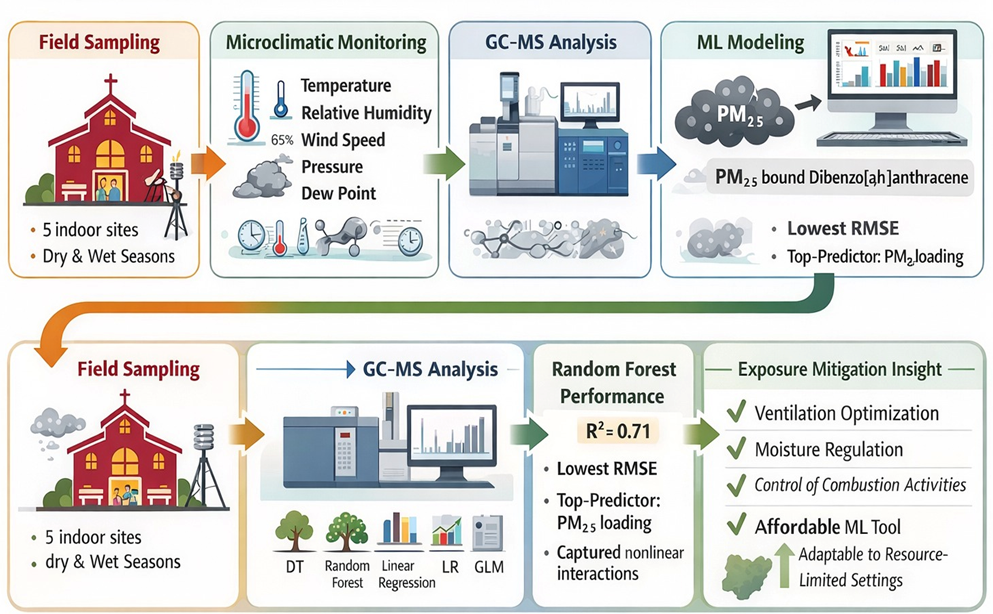
Polycyclic aromatic hydrocarbons (PAHs) are hazardous semivolatile organic compounds frequently detected in indoor environments, several of which are designated by the United States Environmental Protection Agency (USEPA) as priority pollutants due to their carcinogenic potential. Dibenzo[a,h]anthracene (DahA), a high-molecular-weight PAH strongly associated with combustion-derived particulate matter, is classified by the International Agency for Research on Cancer (IARC) as probably carcinogenic to humans. This study applied supervised machine learning (ML) to predict indoor concentrations of PM₂.₅-bound DahA in children’s church facilities in Ugbowo, southern Nigeria, using microclimatic predictors. A total of 30 indoor air samples were collected from 5 locations across dry and wet seasons, and concentrations of the 16 USEPA priority PAHs were quantified by gas chromatography–mass spectrometry. Concurrent measurements of temperature, relative humidity, wind speed, atmospheric pressure, and dew point were obtained. Decision tree (DT), random forest (RF), linear regression (LR), and generalized linear model (GLM) algorithms were trained and evaluated using mean squared error (MSE), root mean squared error (RMSE), and the coefficient of determination (R²). Random Forest outperformed the other models (R² = 0.71), demonstrating superior capability in capturing nonlinear interactions between PM₂.₅ loading and microclimatic variables. While DahA prediction showed greater variability due to relatively low ambient concentrations, the Random Forest model effectively reproduced temporal and microenvironmental trends in DahA concentrations. The results demonstrate the utility of ensemble ML approaches for indoor PAH assessment and highlight the relevance of microclimatic controls for exposure mitigation in child-centric indoor environments.
Downloads
Article Details
Section

This work is licensed under a Creative Commons Attribution-NonCommercial 4.0 International License.
How to Cite
References
Archibong, U. D. & Okuo, J. M. (2024). Correlation of Fine Particulates and Meteorological Parameters in Indoor Public Schools Environment within Benin City, Nigeria. Journal of Materials & Environmental Sustainability Research, 4(2), 30–38. https://doi.org/10.55455/jmesr.2024.006
Archibong, U. D., Okuo, J. M., & Agho, T. (2025). Characterization and modeling of indoor PM2.5-bound benzo[a]pyrene concentration in public schools: A comparative study of Oredo and Uhunmonde local government areas (LGAs), Edo State, Nigeria. Pakistan Journal of Analytical & Environmental Chemistry, 26(2), 240–256. https://doi.org/10.21743/pjaec/2025.12.06.
Choi, H., Harrison, R., Komulainen, H., Hites, R., Toriba, A., Hayakawa, K., et al. (2010). Polycyclic aromatic hydrocarbons. In WHO Guidelines for Indoor Air Quality: Selected Pollutants (pp. 61–120). Geneva: World Health Organization.
Fang, G. C., Chang, K. F., Lu, C., & Bai, H. (2002). Toxic equivalency factors study of polycyclic aromatic hydrocarbons (PAHs) in Taichung City, Taiwan. Toxicology and industrial health, 18(6), 279–288. https://doi.org/10.1191/0748233702th151oa.
Gao, X., Wang, Z., Sun, X., Gao, W., Jiang, W., Wang, X., Zhang, F., Wang, X., Yang, L., & Zhou, Y. (2024). Characteristics, source apportionment and health risks of indoor and outdoor fine particle-bound polycyclic aromatic hydrocarbons in Jinan, North China. PeerJ, 12, e18553. https://doi.org/10.7717/peerj.18553
Goudarzi, N., Shahsavani, D., Emadi-Gandaghi, F., & Arab Chamjangali, M. (2014). Application of random forests method to predict the retention indices of some polycyclic aromatic hydrocarbons. Journal of Chromatography A, 1333, 25–31. https://doi.org/10.1016/j.chroma.2014.01.048.
Guo, L. C., Bao, L. J., She, J., & Zeng, E. Y. (2014). Significance of wet deposition to removal of atmospheric particulate matter and polycyclic aromatic hydrocarbons: A case study in Guangzhou, China. Atmospheric Environment, 83, 136–144. https://doi.org/10.1016/j.atmosenv.2013.11.012.
Hui, X., Guo, S., Shi, X., Yang, W., Pan, J., & Gao, H. (2024). Machine learning-based analysis and prediction of meteorological factors and urban heatstroke diseases. Frontiers in Public Health, 12, 1420608. https://doi.org/10.3389/fpubh.2024.1420608
International Agency for Research on Cancer (IARC). (1987). Some non-heterocyclic polycyclic aromatic hydrocarbons and related exposures (Vol. 92, pp. 27–144). Lyon: IARC. [Monograph evaluating carcinogenic risks, includes dibenzo[a,h]anthracene (Group 2A)]
Izevbigie, E. & Omagamre, W. (2026). Lung Cancer Risk Associated with PM2.5-Bound Polycyclic Aromatic Hydrocarbons in a University Cafeteria in Southern Nigeria. 1-10. https://doi.org/10.21203/rs.3.rs-8507014/v1.
Kanchana-at, T., Trivitayanurak, W., Chy, S., & Bordeerat, N. K. (2025). Particulate-Bound Polycyclic Aromatic Hydrocarbons and Heavy Metals in Indoor Air Collected from Religious Places for Human Health Risk Assessment. Atmosphere, 16(6), 678. https://doi.org/10.3390/atmos16060678.
Mastral, A. M., Callén, M. S., García, T., & López, J. M. (2001). Benzo[a]pyrene, benzo[a]anthracene, and dibenzo[a,h]anthracene emissions from coal and waste tire energy generation at atmospheric fluidized bed combustion (AFBC). Environmental Science & Technology, 35(13), 2645–2649. https://doi.org/10.1021/es0015850.
Racić, N., Ružičić, S., Petrić, V., Terzić, T., Antunović, M., Škaro, I., et al. (2026). Assessment of contributors to airborne PAHs and heavy metals in PM₁₀ using temporal, spatial, traffic and heating data in explainable machine learning models. Atmospheric Environment: X, 29, 100413. https://doi.org/10.1016/j.aeaoa.2026.100413
Rajesh, M., Babu, R. G., Moorthy, U., & Easwaramoorthy, S. V. (2025). Machine learningdriven framework for realtime air quality assessment and predictive environmental health risk mapping. Scientific reports, 15(1), 28801. https://doi.org/10.1038/s41598-025-14214-6.
Salleh, S. F., Suleiman, A. A., Daud, H., Othman, M., Sokkalingam, R., & Wagner, K. (2023). Tropically Adapted Passive Building: A Descriptive-Analytical Approach Using Multiple Linear Regression and Probability Models to Predict Indoor Temperature. Sustainability, 15(18), 13647. https://doi.org/10.3390/su151813647
Taylor, E. T., Wirmvem, M. J., Sawyerr, V. H., & Nakai, S. (2015). Characterization and determination of PM2.5-bound polycyclic aromatic hydrocarbons (PAHs) in indoor and outdoor air in Western Sierra Leone. Journal of Environmental & Analytical Toxicology, 5(5), Article 307. https://doi.org/10.4172/2161-0525.1000307.
United States Environmental Protection Agency. (2022). NAAQS Table. Last updated February 7, 2024. [Accessed 2024].
Wang, D., Wu, S., Gong, X., Ding, T., Lei, Y., Sun, J., & Shen, Z. (2023). Characterization and Risk Assessment of PM2.5-Bound Polycyclic Aromatic Hydrocarbons and their Derivatives Emitted from a Typical Pesticide Factory in China. Toxics, 11(7), 637. https://doi.org/10.3390/toxics11070637.
Wang, M., Jia, S., Lee, S. H., Chow, A., & Fang, M. (2021). Polycyclic aromatic hydrocarbons (PAHs) in indoor environments are still imposing carcinogenic risk. Journal of Hazardous Materials, 409, 124531. https://doi.org/10.1016/j.jhazmat.2020.124531
World Health Organization. (2021). WHO global air quality guidelines: Particulate matter (PM₂.₅ and PM₁₀), ozone, nitrogen dioxide, sulphur dioxide and carbon monoxide. World Health Organization
Yang, X., Li, Y., Liu, L., & Zang, Z. (2025). Prediction of respiratory diseases based on random forest model. Frontiers in public health, 13, 1537238. https://doi.org/10.3389/fpubh.2025.1537238
Yenkikar, A., Mishra, V. P., Bali, M., & Ara, T. (2025). Explainable forecasting of air quality index using a hybrid random forest and ARIMA model. MethodsX, 15, 103517. https://doi.org/10.1016/j.mex.2025.103517.
Zeini, H. A., Al-Jeznawi, D., Imran, H., Bernardo, L. F. A., Al-Khafaji, Z., & Ostrowski, K. A. (2023). Random Forest Algorithm for the Strength Prediction of Geopolymer Stabilized Clayey Soil. Sustainability, 15(2), 1408. https://doi.org/10.3390/su15021408.
Zhang, H., & Srinivasan, R. (2021). A biplot-based PCA approach to study the relations between indoor and outdoor air pollutants using case study buildings. Buildings, 11(5), 218. https://doi.org/10.3390/buildings11050218.
Zhang, Y., Guo, Z., Peng, C., & Li, A. (2024). Random forest insights in prioritizing factors and risk areas of soil polycyclic aromatic hydrocarbons in an urban agglomeration area. Science of the Total Environment, 957, 177583. https://doi.org/10.1016/j.scitotenv.2024.177583.