

SPECTROPHOTOMETRIC DETERMINATION OF ASCORBIC ACID (VITAMIN C) AND SELENIUM CONTENT IN SELECTED FRUIT JUICES
Article Sidebar
Main Article Content
Abstract
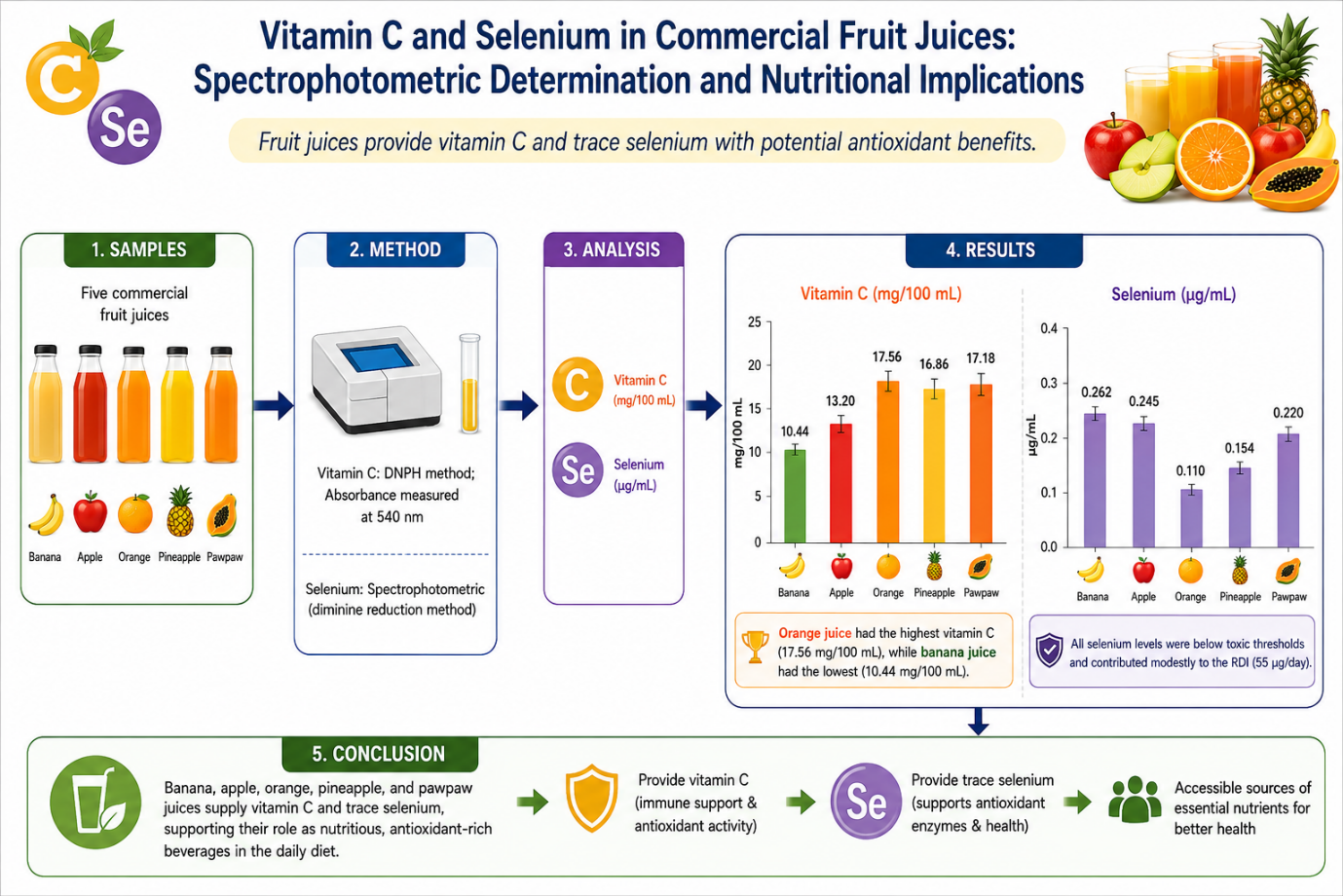
A spectrophotometric method was employed to quantify the ascorbic acid (vitamin C) and selenium content in selected fruit juices. Five fruit juice samples—banana, apple, orange, pineapple, and pawpaw—were analyzed. Vitamin C concentrations were determined by measuring absorbance at 540 nm using a UV–Visible spectrophotometer (Model 1601, Shimadzu, Japan). The results revealed that orange juice contained the highest vitamin C content (17.56 ± 0.21 mg/100 mL), followed closely by pawpaw (17.18 ± 0.63 mg/100 mL) and pineapple (16.86±0.46 mg/100 mL), whereas banana juice had the lowest level (10.44 ± 0.29 mg/100 mL). Selenium concentrations were measured in the same samples, yielding values of 0.262 ± 0.009, 0.245 ± 0.013, 0.110±0.016, 0.154 ± 0.007, and 0.220 ± 0.019 µg/mL for banana, apple, orange, pineapple, and pawpaw juices, respectively. All selenium levels were below toxic thresholds and contributed modestly to the recommended daily intake for adults (55 µg/day). The variation in vitamin C and selenium content among the samples may reflect differences in fruit species, ripeness, and post-harvest handling. The findings suggest that these fruit juices provide dietary vitamin C while supplying trace amounts of selenium, supporting their role as nutritious beverages with potential antioxidant benefits. This study underscores the importance of fruit juices as accessible sources of essential nutrients in daily diets.
Downloads
Article Details
Section

This work is licensed under a Creative Commons Attribution-NonCommercial 4.0 International License.
How to Cite
References
References
[1] Youness, R. A., Dawoud, A., ElTahtawy, O., & Farag, M. A. (2022). Fat-soluble vitamins: updated review of their role and orchestration in human nutrition throughout life cycle with sex differences. Nutrition & metabolism, 19(1), 60. https://doi.org/10.1186/s12986-022-00696-y
[2] Andrès, E., Lorenzo-Villalba, N., Terrade, J.-E., & Méndez-Bailon, M. (2024). Fat-Soluble Vitamins A, D, E, and K: Review of the Literature and Points of Interest for the Clinician. Journal of Clinical Medicine, 13(13), 3641. https://doi.org/10.3390/jcm13133641
[3] García Benzal, J. D., Aiello, P., Moreno, D. A., García Viguera, C., &Villaño, D. (2022). Vitamins. In C. M. Galanakis (Ed.), Nutraceutical and functional food components (2nd ed., pp. 183–241). Academic Press. https://doi.org/10.1016/B978-0-323-85052-0.00004-0
[4] Hrubša, M., Siatka, T., Nejmanová, I., Vopršalová, M., KujovskáKrčmová, L., Matoušová, K., Javorská, L., Macáková, K., Mercolini, L., Remião, F., Máťuš, M., Mladěnka, P., & on behalf of the OEMONOM. (2022). Biological Properties of Vitamins of the B-Complex, Part 1: Vitamins B1, B2, B3, and B5. Nutrients, 14(3), 484. https://doi.org/10.3390/nu14030484
[5] Al Majidi, M., &Alqubury, H. Y. (2016). Determination of vitamin C (ascorbic acid) contents in various fruit and vegetable by UV-spectrophotometry and titration methods. Journal of Chemical and Pharmaceutical Sciences, 9(4), 2972–2974.
[6] Shahidin, Wang, Y., Wu, Y., Chen, T., Wu, X., Yuan, W., Zhu, Q., Wang, X., & Zi, C. (2025). Selenium and selenoproteins: Mechanisms, health functions, and emerging applications. Molecules, 30(3), 437. https://doi.org/10.3390/molecules30030437
[7] Bano, I., Hassan, M. F., &Kieliszek, M. (2025). A comprehensive review of selenium as a key regulator in thyroid health. Biological Trace Element Research, 203, 6466–6480. https://doi.org/10.1007/s12011-025-04653-7
[8] Bisrat, M. H., Redi-Abshiro, M., Chandravanshi, B. S., & Yaya, E. E. (2022). New analytical methods for the determination of ascorbic acid content in aqueous extracts of flesh, peel and seeds of pumpkin (Cucurbita maxima). Bulletin of the Chemical Society of Ethiopia, 36(2), 277–290. https://doi.org/10.4314/bcse.v36i2.3
[9] Oliveira, A., Lameiras, J., Mendes-Moreira, P., & Botelho, G. (2024). Antioxidant capacity and cardiovascular benefits of fruits and vegetables: A proposal for comparative scales. Nutraceuticals, 4(4), 695–709. https://doi.org/10.3390/nutraceuticals4040039
[10] Staden, R.-I. S.-v. (2020). Quality and reliability in analytical chemistry. Proceedings, 55(1), 8. https://doi.org/10.3390/proceedings2020055008
[11] Wallace, T. C., Bailey, R. L., Blumberg, J. B., Burton-Freeman, B., Chen, C.-Y. O., Crowe-White, K. M., et al. (2020). Fruits, vegetables, and health: A comprehensive narrative, umbrella review of the science and recommendations for enhanced public policy to improve intake. Critical Reviews in Food Science and Nutrition, 60(13), 2174–2211. https://doi.org/10.1080/10408398.2019.1632258
[12] Rathore, A. S., Chakraborty, D., & Sarin, D. (2025). Rapid high performance liquid chromatography methodologies for analytical characterization of biotherapeutic products. Journal of Chromatography Open, 8, 100272. https://doi.org/10.1016/j.jcoa.2025.100272
[13] Arias, A., Feijoo, G., & Moreira, M. T. (2022). Exploring the potential of antioxidants from fruits and vegetables and strategies for their recovery. Innovative Food Science & Emerging Technologies, 77, 102974. https://doi.org/10.1016/j.ifset.2022.102974
[14] Abera, H., Abdisa, M., & Washe, A. P. (2020). Spectrophotometric method for the determination of ascorbic acid in M. stenopetala leaves through catalytic titration with hexavalent chromium and its validation. International Journal of Food Properties, 23(1), 999–1015. https://doi.org/10.1080/10942912.2020.1775249
[15] Igwe, P. U., & Onyebuchi, E. J. (2021). Heavy metals in edible fruits: A review. International Journal of Environment, 10(1), 1–14. https://doi.org/10.36632/ije/2021.10.1.1
[16] Centers for Disease Control and Prevention. (2020). Laboratory procedure manual: Vitamin C (ascorbic acid), NHANES 2017–2018. U.S. Department of Health and Human Services.
[17] Abe-Matsumoto, L. T., Sampaio, G. R., & Bastos, D. H. M. (2020). Is titration as accurate as HPLC for determination of vitamin C in supplements? American Journal of Analytical Chemistry, 11, 269–279. https://doi.org/10.4236/ajac.2020.117021
[18] Subedi, S., Adhikari, D., & Poudel, B. (2022). Determination of heavy metals in varieties of fresh and packaged fruit juices along with powdered fruit drink mixes in Kathmandu Valley. Journal of Balkumari College, 11, 63–69. https://doi.org/10.3126/jbkc.v11i1.53024
[19] Sori, C. A., &Fayissa, G. R. (2025). Comparative investigation of the level of vitamin C in wild edible plants consumed at North Shoa Zone, Oromia region, Ethiopia. Discovery Food, 5, 300. https://doi.org/10.1007/s44187-025-00614-0
[20] Ruxton, C. H. S., & Myers, M. (2021). Fruit juices: Are they helpful or harmful? An evidence review. Nutrients, 13(6), 1815. https://doi.org/10.3390/nu13061815
[21] National Center for Environmental Health, Division of Laboratory Sciences, Nutritional Biomarkers Branch. (2020).Laboratory procedure manual: Vitamin C (ascorbic acid) in serum by liquid chromatography electrochemical detection (Method No. 4031.01, Revised 06/2020). Centers for Disease Control and Prevention. https://www.cdc.gov
[22] Andaririt, D. R., Purnaningtyas, S. R. D., &Wijayanto, A. (2025). Validation of the UV-Vis spectrophotometric method for the determination of ascorbic acid content in beverage preparations based on a standard vitamin C calibration curve. Open Access Health Scientific Journal, 6(2), 249–257. https://doi.org/10.55700/oahsj.v6i2.101
[23] Codex Alimentarius Commission. (2025). Standard for food-grade salt (CXS 150-1985). Food and Agriculture Organization of the United Nations & World Health Organization. https://www.fao.org/fao-who-codexalimentarius/standards/list-standards/en/
[24] Hong, L. K., & Diamond, A. M. (2020). Selenium. In B. P. Marriott, D. F. Birt, V. A. Stallings, & A. A. Yates (Eds.), Present knowledge in nutrition (11th ed., pp. 443–456). Cambridge, MA: Academic Press.
[25] Food and Agriculture Organization of the United Nations, & World Health Organization. (2004). Vitamin and mineral requirements in human nutrition (2nd ed.). World Health Organization. https://www.who.int/publications/i/item/9241546123
[26] World Health Organization. (2011). Selenium in drinking-water: Background document for development of WHO guidelines for drinking-water quality. World Health Organization. https://www.who.int/publications/i/item/9789241501943
[27] Guo, F., Liu, R., Chen, D., & Yu, X. (2026). Unveiling the power of selenium: Selenoproteins in antioxidant defense and immune regulation. In Selenium—Environmental pathways and health implications. IntechOpen. https://doi.org/10.5772/intechopen.1015084
[28] Institute of Medicine, Food and Nutrition Board. (2000). Dietary reference intakes: Vitamin C, vitamin E, selenium, and carotenoids. Washington, DC: National Academy Press. https://pubmed.ncbi.nlm.nih.gov
[29] Pan, S., Liu, X., Guo, Q., Zheng, X., Wu, J., Liu, G., Song, Y., Wu, M., & Yan, X. (2026). Systematic study on the selenium enrichment mechanism and regulatory strategies of selenium-enriched navel oranges. Journal of Food Composition and Analysis, 152, 109025. https://doi.org/10.1016/j.jfca.2026.109025
[30] Crespo, L., Gaglio, R., Martínez, F. G., Moreno Martin, G., Franciosi, E., Madrid-Albarrán, Y., Settanni, L., Mozzi, F., &Pescuma, M. (2021). Bioaccumulation of selenium-by fruit origin lactic acid bacteria in tropical fermented fruit juices. LWT, 151, 112103. https://doi.org/10.1016/j.lwt.2021.112103
[31] Genchi, G., Lauria, G., Catalano, A., Sinicropi, M. S., & Carocci, A. (2023). Biological activity of selenium and its impact on human health. International Journal of Molecular Sciences, 24(3), 2633. https://doi.org/10.3390/ijms24032633
[32] Hu, Z., Xiong, X., Bu, J., Xiao, C., & Zhang, J. (2024). Form, Bioavailability, and Influencing Factors of Soil Selenium in Subtropical Karst Regions of Southwest China. Applied Sciences, 14(12), 5192. https://doi.org/10.3390/app14125192
[33] Lippman, S. M., Klein, E. A., Goodman, P. J., Lucia, M. S., Thompson, I. M., et al. (2009). Effect of selenium and vitamin E on risk of prostate cancer and other cancers: The Selenium and Vitamin E Cancer Prevention Trial (SELECT). JAMA, 301(1), 39–51. https://pubmed.ncbi.nlm.nih.gov
[34] Oyeyiola, O. A., &Adetunde, O. T. (2015). Comparison of ascorbic acid content in fresh fruit juices with packaged fruit juices and drinks in the Lagos, Nigeria market. University of Lagos Journal of Basic Medical Sciences, 3(5)
[35] Pisoschi, A. M., Pop, A., Negulescu, G. P., &Pisoschi, A. (2011). Determination of ascorbic acid content of some fruit juices and wine by voltammetry performed at Pt and carbon paste electrodes. Molecules, 16(2), 1349–1365. https://doi.org/10.3390/molecules16021349
[36] Dossou, R., Missang, C., Baron, A., Renard, C., &Silou, T. (2012). Factors affecting postharvest preservation of safou (Dacryodesedulis (G. Don) H. J. Lam) fruits. Forests, Trees and Livelihoods, 21(1–2). https://doi.org/10.1080/14728028.2012.674677
[37] Lee, S. K., & Kader, A. A. (2000). Preharvest and postharvest factors influencing vitamin C content of horticultural crops. Postharvest Biology and Technology, 20(3), 207–220. https://doi.org/10.1016/S0925-5214(00)00133-2
[38] Iqbal, R. K. (2022). Health importance of fruits in humans. Food Science & Nutrition Technology, 4, 1–7. https://doi.org/10.23880/fsnt-16000204
[39] Casari, S., Di Paola, M., Banci, E., Salou, D., Scarallo, L., Renzo, S., Gori, A., Renzi, S., Paci, M., de Mast, Q., Pecht, T., Derra, K., Kaboré, B., Tinto, H., Cavalieri, D., & Lionetti, P. (2022). Changing dietary habits: The impact of urbanization and rising socio-economic status in families from Burkina Faso in Sub-Saharan Africa. Nutrients, 14(9), 1782. https://doi.org/10.3390/nu14091782
[40] Kunwar, A., Bist, D. R., Khatri, L., Dhami, R., & Joshi, G. R. (2024). Optimizing post-harvest handling practices to reduce losses and enhance quality of fruits and vegetables. Food and Agri Economics Review, 4(2), 78–82. https://doi.org/10.26480/faer.02.2024.78.82